I have been reflecting on ideas of failure in relation to my portfolio of experimentation.
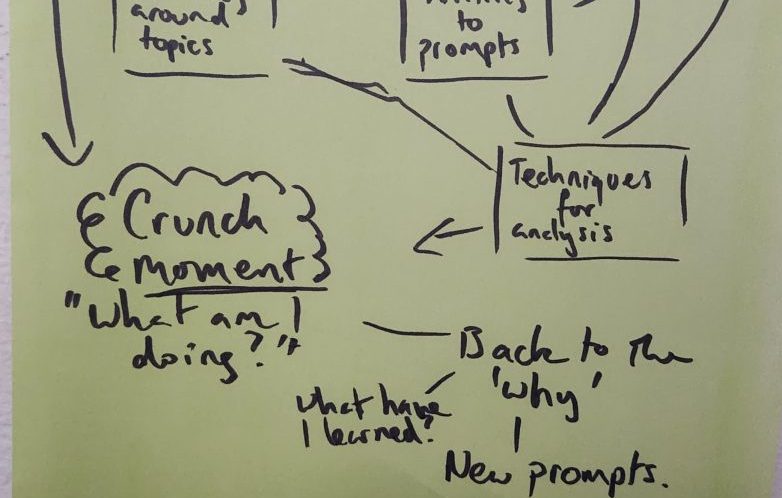
I spent a lot of last week in a deep state of failure. I was struggling to get to grips with what exactly my experiments had been about, and was worried that it had all been for nothing.
During this project, I set out to cultivate an environment for myself in which I could write without any pressure to produce something of quality. I told myself that something was better than nothing. That learnings would come, no matter what I did. That I wouldn’t value-judge what I produced. I leaned into this. I generated writing prompts for myself and took to responding to them in a similar mindset to which I’d been reeling off my morning pages – quick and dirty, almost stream of consciousness, not reflecting on what I was doing but just writing.
However, on arriving at the point where I had to package up these experiments and present them to someone else, I was suddenly very conscious that, not only had I not produced anything of quality, I had deliberately not even tried. I felt like I’d held myself back from the kind of pressure and expectation that I need to produce writing I’m proud of.
Talking to the cohort during our feedback and Fall Festival of Failure session, Marsha reminded me that I had made a deal with myself. I’d promised I wouldn’t value judge. I hadn’t set out to produce writing of quality. My aims had been elsewhere. But what had I set out to produce? What was the point? The other students asked me the same question. Where is this going? What’s the point for you and your practice?
We’re being marked this term against the ‘anticipatory competency’.

If this competency is about being able to look ahead and know what experiments are worth undertaking, had I failed? Starting these experiments, I wrote on my blog:
I’m particularly interested in exploring modes of storytelling and of representing the other (in an expansive sense, where the other is any other person) – and across real and fictionalised lines. Coming from a perspective of interculturality, this will mean engaging with ideas of cultural appropriation and speaking to or with, not for. I’m hoping to challenge the way I navigate between objectivity and subjectivity in my work and shift my relationship with truth – to understand it in a different way.
I think I need to remember that the writing I’ve undertaken has been a small part of my experiments. I’ve also done translation (which, incidentally, I am proud of) and I’ve been developing techniques for reading and analysing my own and others’ writing, as well as undertaking research.
The anticipatory competency is about “affecting challenge or discovery”. I have pushed myself. I have felt challenged and I have discovered new things about how I write, and how I want to write.
And what about where this is going? What’s the point for me and my practice?
I do have a ‘why’, although I’ve perhaps been shy to share it. I have several projects I’d like to develop that require sharing other people’s stories – or how their stories interact with my own. These stories and their characters will cross borders. Not being confident about how to do this in a sensitive and conscientious way has been holding me back. These projects will sit within a more creative realm than much of my previous writing. They’re not fiction, but I think they could be strengthened by employing techniques from fiction. One involves forms of memoir, and I’m aware I will be writing from my subjective perspective, likely drawing on narrative structures and potentially wanting to fictionalise details or fill in gaps.
These experiments have given me the opportunity to explore how I might go about this, and to unpick some of the thorny ethical issues I feel myself getting caught on. I’ve also learned techniques for pushing myself through the mental blocks that stop me from even getting started. For facing the blank page.
I’m feeling a little less of a failure this week.
Leave a Reply