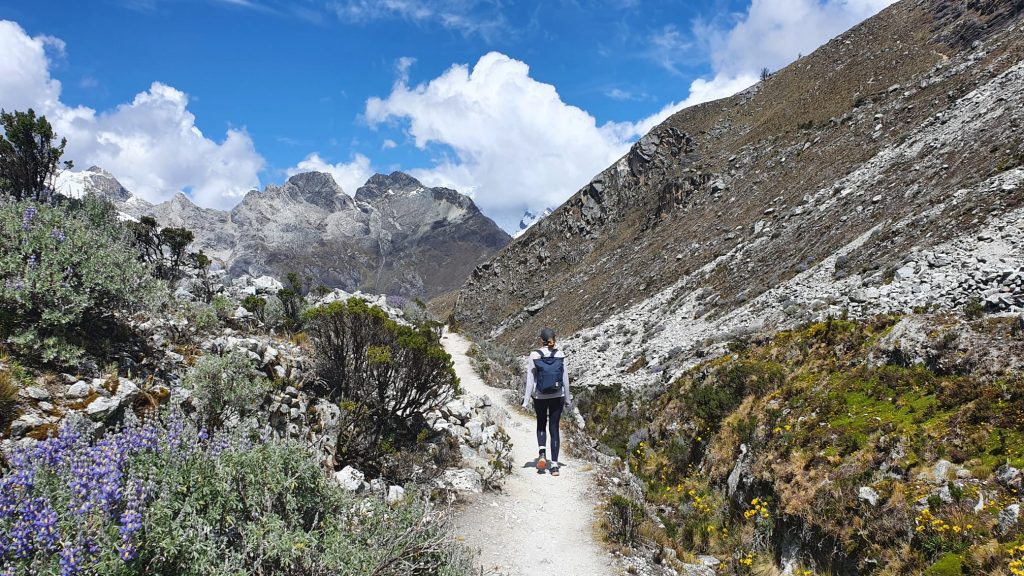
For my REBEL project, I’m planning to reflect on my experience of travel and looking to understand it as learning gain, for me personally and in relation to my practice as a writer and communicator. I will be analysing how these experiences have shaped my ways of thinking, ways of being, and doing. And how it has changed my interests, attitudes, and capabilities.
I’ve taken the name for my project ‘Wayfaring’ from a theory by anthropologist Tim Ingold’. In ‘Being alive: essays on movement, knowledge anddescription’, he writes:
“Lives are led not inside places but through, around, to and from them, from and to places elsewhere. I use the term wayfaring to describe the embodied experience of this perambulatory movement. It is as wayfarers, then, that human beings inhabit the earth.”
It’s this sense of interconnectedness, embodiment and movement that I want to embed in my project.
I spent more than two years travelling in south, central and north America and have since settled in Mexico. I had a hugely wide range of experiences during this time that I could reflect on, but for the purposes of REBEL, I’ve come to define this experience as having three key qualities:
- That of living ‘outside’ of daily life – of routine, time, rhythms and demands.
- The abundance and quality of connections with new people.
- Being immersed in newness – a foreign language, a different culture, unfamiliar experiences – which heightens awareness and observation skills.
Methodology
I am putting together a series of ‘vignettes’ that activate these three qualities and evidence the new ways of thinking, being and doing they brought about.
These will be shared through:
- New and past writing about memories, including diaries and photos
- Mapping of connections and choices
- Analysis of writing produced, including communications work, creative and journalistic
I’m also planning to use conversation as part of my process – talking to a friend who travelled with me for part of this time. Conversation is a key part of my creative process and I see it as a site of learning and knowledge gain, so I’m interested in practising this as part of my enquiry.
And of course, reflection through writing and diagramming.
The context of this investigation
I will be considering the specific contexts that I travelled in, my relationship to them and how this affected my experience. But I will also be considering the wider contexts of the discourse around travel. Such as:
- That travel is often framed as an experience of personal growth – I’m interested in interrogating this to see in what ways it was true for me.
- The history of travel – its imperialist routes and place within global sociocultural systems today, including anti-tourism movements and environmental issues
- The changing nature of travel in the internet age
Key references
Two texts have informed my thinking in relation to this so far: Alain de Botton’s ‘The Art of Travel’, in which he reflects on the quality of experience of travel; and ‘The Intercultural Mind’ by Joseph Shaules, in which he brings together neuroscience and psychology to understand the effect on the brain of being immersed in a foreign culture and to reflect on how we can better navigate these experiences.
How this relates to my practice
My experiences travelling have been formative for my writing practice – they have influenced what and how I want to write. As a result, much of my recent writing can be seen to sit within the realm of travel writing.
I have the intuition that the mindset that travelling offered me – that the competencies and attitudes I developed during this time – were beneficial for my writing. I think this is something that could benefit from closer analysis and reflection.
And this type of enquiry sits at the intersection of art, philosophy, psychology and neuroscience, which is a territory I’ve found myself drawn in all my recent projects.
In my practice as an arts communicator, I work closely with artists who create performance and live encounters, and I’m beginning to expand my practice through dialogic projects into live encounter as well. I’m interested in considering travel as a cultural practice, one that creates the circumstances for encounters between strangers. Looking ahead to my final project, I’m currently thinking about how to incorporate aspects of live encounter – and possibly travel – in my archive of decisions project, and this investigation will feed into that.
My theme: Cooperative practices
I will be analysing this through the theme of ‘Cooperative practices’. This acknowledges that travel – even solo travel – is enacted in relation to others. It’s about communication, interpersonal connections and action that affects and depends on others. I also see writing as a deeply connected practice.
So this means I’ll be reflecting on how I’ve developed learning and competencies related to
- Participation & collaboration – development of empathy, and ways of acting, negotiating and understanding that respect the needs & perspectives of others
- Self-Awareness & reflection – understanding my role within local and global collectives and communities.
My assessment criteria will be
- Process: my means of enquiry through writing, mapping, conversation and reflection
- Realisation: how well I present the story of this learning for an outside eye
Some open questions I’ll be considering as I’m putting together my portfolio of evidence and reflections.
- How did my ‘paths’ (Ingold) intersect with others during this time? How my experiences changed the way I relate to others?
- What are the stories I tell myself about this time and what can I learn from interrogating them objectively?
- What new ways of thinking, being and doing, did the particular qualities of experience of travel generate and what have been the lasting changes from these?
- In what ways can I understand a practice of travel as symbiotic with a practice of writing?
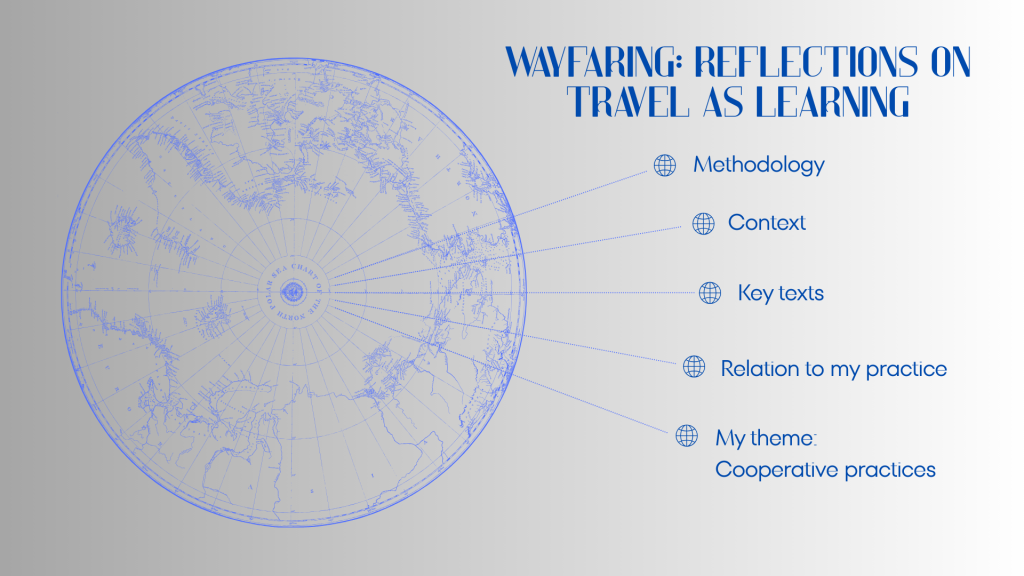
This was the text of a presentation I gave at the REBEL symposium about my project in process.
References
Ingold, T. (2011) Being alive: essays on movement, knowledge and description. London: Routledge.
de Botton, A. (2002) The Art of Travel. New York: Vintage International.
Shaules, J. (2007) The Intercultural Mind: Connecting Culture, Cognition, and Global Living. Boston: Intercultural Press.
Buckland, B. (2024) ‘Trekking Across Switzerland, Guided by Locals’ Hand-Drawn Maps’, The New York Times, 17 July. Available at: https://www.nytimes.com/interactive/2024/07/17/travel/switzerland-local-maps.html (Accessed: 11 December 2025).
Leave a Reply