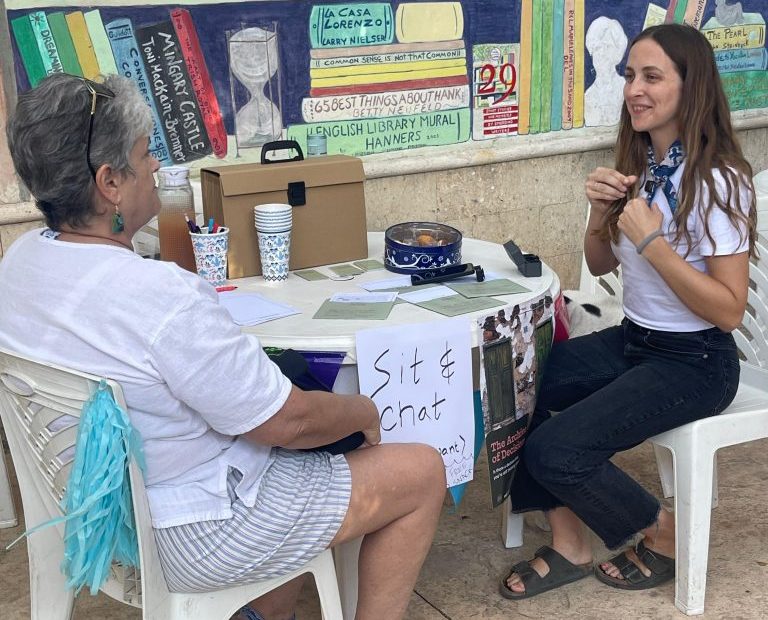
I have now delivered 3 days of decision-collecting activities in Mérida. I made reflective voicenotes at the end of each day and have used AI to help me to summarise the key points here.
Day 1 – Friday (Mérida English Library)
- Conducted 5 recorded audio interviews with members of the public contributing a decision to the archive
- Had informal conversations with a few additional people and distributed printed sheets about the project
- Chatted with library staff
- Experimented with different ways of introducing the project, in both English and Spanish
- Displayed a ‘sit and chat’ sign at a table in the library
Day 2 – Tuesday
- Ran a morning session at the Mérida English Library (approx. 3 hours); conducted one recorded audio interview with a retired American man who had been attending a Tai Chi class
- Joined a group of women crocheting toys for hospitalised children, participating in their activity and informally introducing the project to them
- Scouted two potential new venues: the General (public) Library and Punto Mid cultural centre/bookshop/café
- Attended craft group, where one previous participant gave feedback on her experience; distributed project cards to two new attendees
Day 3 – Wednesday
- Attended the writers’ group at the Mérida English Library and shared a piece of writing conceived as a reading of the archive — a brief text summarising each decision contributed so far, delivered bilingually (each decision in the language it was submitted; framing in English)
- Set up a table, chair, lamp, and handwritten signs in Parque La Plancha, then later on Paseo Montejo, to engage Spanish-speaking members of the public; conducted one interview in each location before being moved on by authorities both times
- Worked with a collaborator (Adrián) to approach Spanish speakers in public space and distribute project cards
- Distributed cards in several locations around Mérida including the English Library, Sempere café and bookshop, and by hand on the street
Reflections on the Activity Delivered
In MEL
- All contributors chose to give their decision via audio interview rather than through written or other formats – this was unexpected and suggested audio felt like the path of least effort
- Conversations were shorter than anticipated (8–15 minutes; one outlier at 23 minutes) but this felt appropriate rather than disappointing
- People showed little interest in reading others’ contributions or in asking what would be done with their own – need to find a separate audience for the archive?
- There was a noticeable risk of unintentionally influencing the content of people’s contributions by mentioning specific decisions or themes
- A thematic cluster emerged around moving city/country and in these a recurring tension between moving feeling like a genuine choice versus a forced response to circumstances
- A recurring thread across contributions was the relationship between age and decision-making – pressure to reach certain milestones, shifts in how decisions are approached, and awareness of mortality
- The mode felt more like interview than conversation — the project held space for listening rather than mutual exchange, which felt different from U3 conversation work
- The deeper themes of interest to the project — agency, consciousness, the degree to which choices are truly free – weren’t addressed directly but were legible in the texture of how people spoke
- Feedback from one participant was affirming: she described the conversation as cathartic, like therapy, and said it had surfaced things she hadn’t previously processed — a strong signal of the project’s relational and reflective value. Another expressed discomfort at the idea of intimate conversations being placed in a public archive — a useful data point about participant hesitation, particularly among older American demographics, and a prompt to consider written contribution as an alternative mode for that group
On the ‘reading’ of the archive
- The bilingual reading in the writers’ group felt slightly uncomfortable to deliver — switching between languages mid-text is still uncertain territory, and confidence in the Spanish sections was limited, despite this, it felt right and intentional to bring Spanish into that space, given the project’s context in Mexico and the reading prompted a lively group discussion about decision-making in people’s own lives
- The summary/survey format of the reading prompted a question from one participant about where the substance was — a useful challenge that points toward the difficulty of representing archive material in excerpted form without losing its depth
In public space
- The handwritten sign asking ‘is there a decision you’re still thinking about?’ worked very differently from the project poster – it drew in people who were actively in the middle of a difficult decision, rather than those open to reflecting on a past one; this is a valuable distinction but represents a different kind of contribution than the archive is primarily seeking
- The two street conversations were with people in acute indecision – a different tenor to the reflective contributions gathered in the library
- The first street conversation was difficult: the participant was discussing something sensitive around health, Adrián was absent, and my Spanish wasn’t adequate to respond with the sensitivity the moment required – a clear prompt to plan for more active translation support
- Being moved on from both public locations highlighted the need to obtain permissions before setting up furniture in public space
Leave a Reply